I walked into the bathroom, and my cousin was already inside the shower. This was routine; I was only about eight years old, and not yet able to fully comprehend the sexualization of naked bodies. Showering with my cousin Amanda was normal – in fact, it was a fun childhood experience. Playing with dolls in the bathtub, talking in the shower, creating fake beards and crazy hair with the soapy water. But it had been a while since we had showered together, and something was different. She is older than me, about six years older than me, and her body was changing and shifting in ways that mine was not. I was confused and anxious as I looked in on her through the glass. Hair had grown in places where there hadn’t been any before, and there were hills and valleys across her body where things used to be flat.
Later, I asked my mom what had happened. What was different? Was my body going to do the same things that Amanda’s had? My mom answered calmly, explaining that Amanda was becoming a woman, and indeed, I too would go through similar changes in the future. Becoming a woman? What does that mean? What does it mean to be a woman? And now I ask, what does it mean to be a woman in the 21st century?
Claire Heuchan is a self-described Black radical feminist and is the author of the blog Sister Outrider. She won the Best Blog category for the 2016 Write to End Violence Against Women Awards and was shortlisted for the Emma Humphreys Memorial Prize.
Her blog details a five-part series on sex, gender, and sexuality. Her blog post entitled “Binary or Spectrum, Gender is a Hierarchy,” is intriguing, and I discovered it simply through happenstance. In this piece, she argues that it matters little if gender is understood in terms of a binary between males and females or as a spectrum with a multitude of possible gender identities: gender is still a socially constructed concept, and only serves to grant one group of people (namely, men) dominion over a subordinate counterpart (evidently, women). Heuchan argues that when completely broken down and examined, gender is why women who have been abused or raped get the brunt of the blame, since “she was asking for it” “she shouldn’t have been walking alone at night in an unsafe part of town,” or “she must have provoked him in some way.” Gender is why women are condemned for their sexuality, why only men are allowed to discuss pornography and masturbation, while women are labeled “sluts” if they allow men sexual access to their bodies. And because people are gendered even before they’re born, it becomes impossible to “opt out” of the oppression so inherent in society.
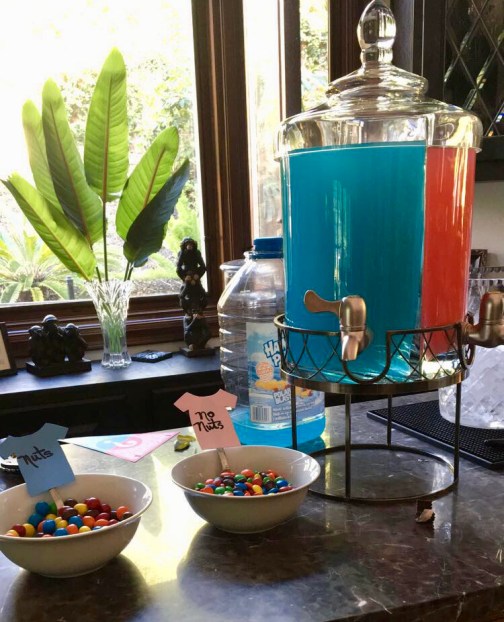
Amanda is now 28 years old, with a daughter of her own turning one in just a few weeks, and has another on the way. Before the birth of my second cousin, Amanda was given two baby showers, and threw a “gender reveal” party. This is not uncommon; in fact, this type of party seems like a trend that an increasing number of expectant mothers are adhering to. She had two different types of punch side-by-side, one blue and one pink. She had M&Ms with either “Nuts” or “No Nuts,” more commonly stated as “Peanut M&Ms” and “Plain M&Ms.” Her closest friend made cupcakes with pink and blue icing inside, and we were all able to guess the sex of the baby on paper ballots before the actual reveal. The guests were called outside into the backyard when the moment was right, and Amanda and her husband stood together with a giant black balloon in their hands, ready to pop it. The countdown began, and soon enough pink confetti was swirling toward the ground as her guests squealed in delight.
Alice Domurat Dreger is a historian, bioethicist, author, and former professor. She works with people at the edge of anatomy, such as conjoined twins and “intersexed people.” Her TED Talk entitled “Is anatomy destiny?” calls into question the hard lines drawn between our social categories, the lines that are actually fuzzy between male and female, among other anatomical distinctions.
Alice Dreger brings up an interesting topic within her talk on anatomical destiny, if you will. She mentions that despite being physically healthy, surgeons will often work to “normalize” their patients, essentially ridding them of anything out of the ordinary. Why? Simply because they threaten the status quo, they threaten our social categories. If someone doesn’t have the “correct” anatomy that fits a particular identity, alterations must be made accordingly. As a society, we hold the concept that what it means to be a woman is to have a female identity, what it means to be a man is to have a male indentity. But sex and gender is more complicated than this. Nature doesn’t draw the line for us between female and male, but rather, we draw that line on nature.
Amanda gave birth in early December, at a women’s hospital in Mission Viejo. It was later in the evening, already dark outside, and cold enough to grab a jacket out of the backseat of my car. As I walked into the hospital, I followed the signs until I reached the right room number. Family surrounded my cousin already, my grandmother having made pink shirts that read “Great Grandma,” “Grandma” “Uncle” or “Daddy.” My second cousin was resting near the bed, in a tiny box-like bed provided by the hospital. She was gorgeous, and “had all the right parts” I was assured by Amanda’s younger brother, Jacob. I suppose that’s all that was needed to be said about that.

 A Composition of Self by Alexis Rivera
Alexis, I hope you received some peer feedback during yesterday’s workshop (I do not see anything posted here). What questions do you have about your draft? What you have here is working, though I think you could reflect more on some of the questions, such as is our anatomy our destiny? What do you think this means? What examples of this are out there? What has happened in your own life where you can say this is true, or not true, for you.
And what does this all mean in terms of being a woman in the 21st century? I suppose if it’s all about anatomy then nothing has changed since the beginning of time, when Adam and Eve showed up!
Try to stay focused on this question of what it means to be a woman in the 21st century (and indeed the answer to this might be that it means what it’s always meant) – but bring us to this discovery. Try to open up each area of this draft and let us know what you’re thinking, struggling to figure out, and discovering.
LikeLike
Professor Lechner,
I have posted some takeaways from the in-class peer workshop on Friday, and hope that this answers some questions for you about my auto-ethnography going forward. I am sure that I will have more questions for you after the draft due this Thursday, but as for right now I will continue to bring the reader into a more cohesive narrative about womanhood in the 21st century, and work to open up the drafts I have already posted. Thank you.
LikeLike
Hi Alexis, sorry I haven’t been actively participating in this autoethnography project. From reading what you have, I think you have a great start to help draw the audience in on your ethnography. I also think your sources are great but I feel as if you need to elaborate more on what Alice Domurat Dreger and Claire Heuchan are saying. And draw new conclusions from what they are saying how it means to be a woman in the 21st century. Other than that, I think this is a great autoethnography and I look forward to reading your final draft.
LikeLike